Data Centres
Data centres depend on what sits below ground: HV power duct banks, diverse fibre entries, generator fuel infrastructure and cooling pipework, all reached through chambers that need reliable, secure, full-width access. That is why R&B UK manufactures and supplies BSI Kitemark certified multi-part access covers, manhole covers and high security cover systems for data centre and critical national infrastructure projects. Everything is held in UK stock or fabricated in our own Telford workshops.
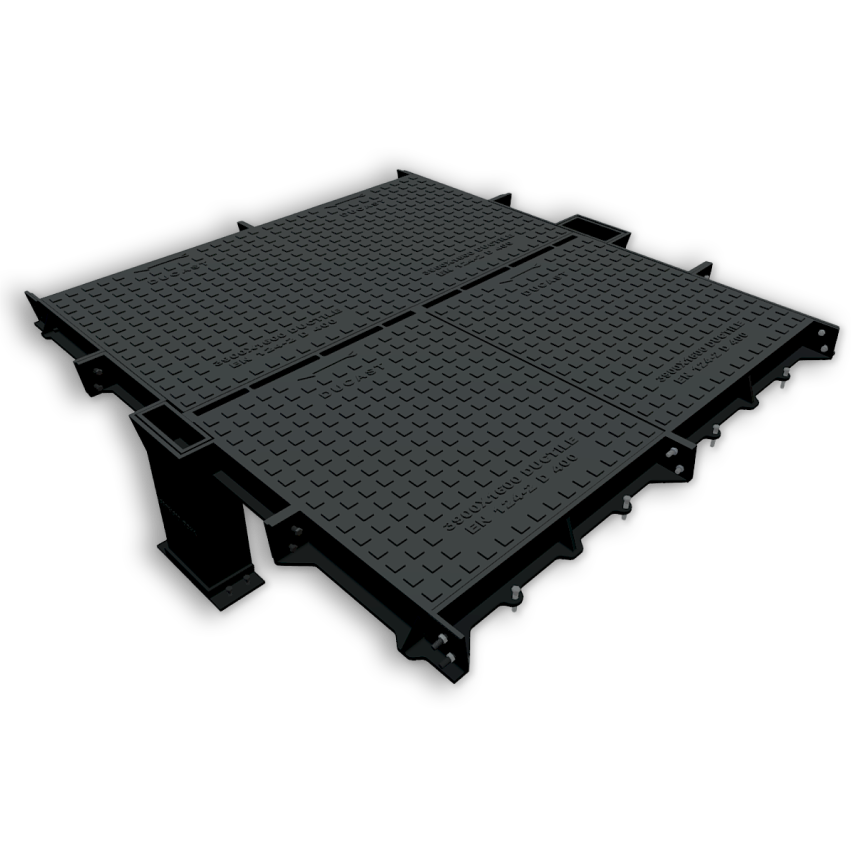
Multi-part access covers for large chamber openings
The chambers that matter most on a data centre campus are rarely a standard single-cover size. Transformer chambers, duct bank draw pits, valve chambers and fuel infrastructure all demand wide, unobstructed openings. Our specialist multi-part ductile iron access covers are engineered for exactly this. The range includes solid top multi-part and concrete infill multi-part covers and frames for large spans, as well as continuous trench covers for cable routes.
Moreover, each configuration is specified to the opening size and loading class the position demands, with machine-seated solid top options where sealing matters. These covers are proven in ports, airports and highways. In other words, they carry the same extreme-duty pedigree that data centre external works call for.
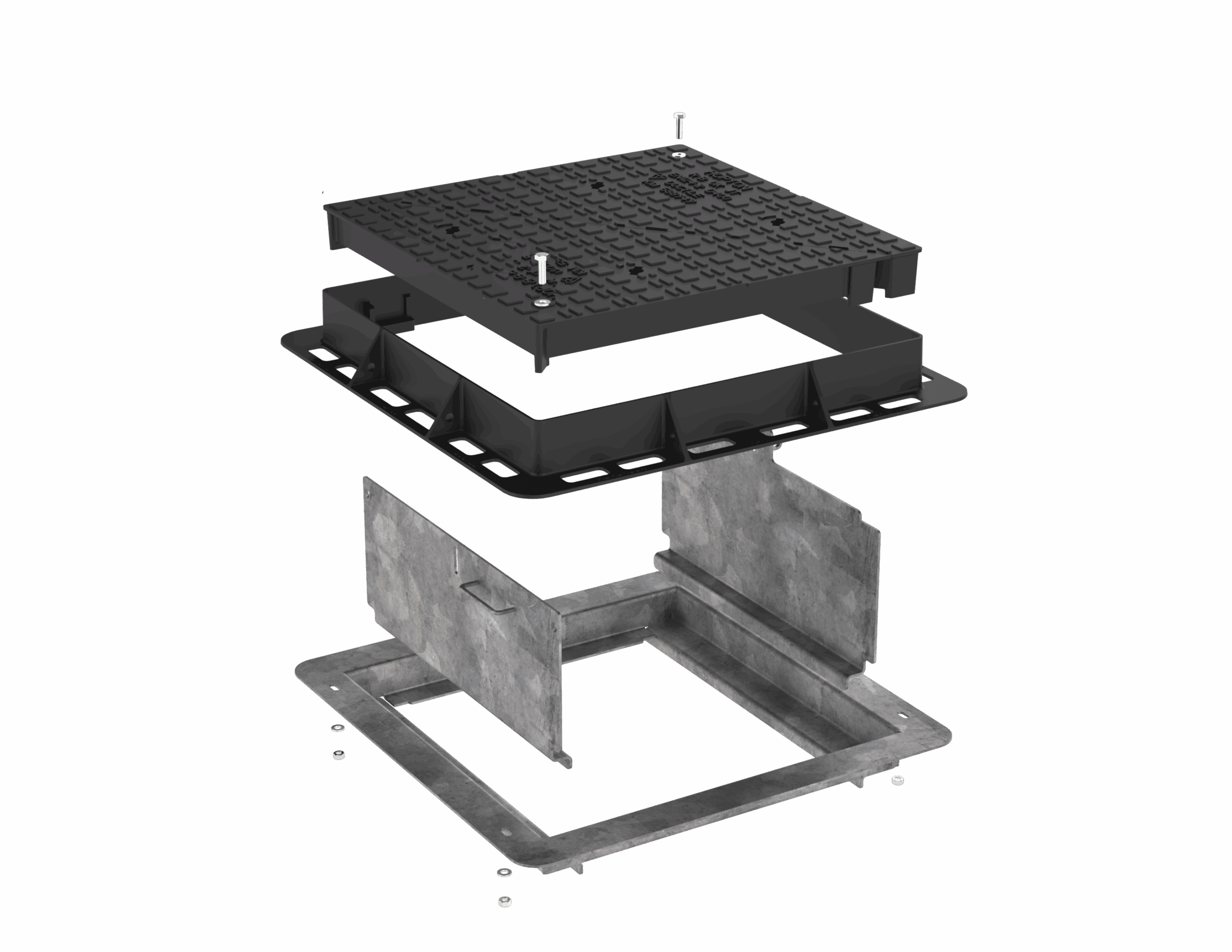
Sentinel: security at every below-ground access point
Below-ground access points are part of a data centre’s security perimeter. If a cover over a power duct or fibre route can be lifted with a pry bar, then it is the weakest point on the site. Our Sentinel range of ultra high security access covers was developed for critical national infrastructure. It combines heavy-duty construction with advanced multi-bolt security locking, for environments where unauthorised access is not an option.
In addition, our bespoke solid top fabricated covers can be specified with double seals, high-security locking, safety grilles and fall-arrest protection — built to your exact opening size.
Which loading class where? Zone-by-zone guide for data centre sites
BS EN 124 loading classes are defined by where a cover is installed, not by the vehicle that occasionally crosses it. Because data centre campuses contain such a wide spread of zones — from landscaped pedestrian areas to crane hardstandings — a single site will typically specify three or four classes. Use this guide as a starting point. Then, for the detail behind each class, see our full BS EN 124 loading classes guide (A15–F900).
| Data centre zone | Typical loading class | Why |
|---|---|---|
| Landscaped areas, cable routes under soft ground | A15 / B125 | Pedestrian and light maintenance access only. |
| Footpaths, walkways between buildings | B125 | Pedestrian areas and paths closed to vehicles. |
| Car parks, staff parking decks | C250 | Cars and light vans; also kerbside channel zones. |
| Perimeter roads, internal access roads | D400 | Carriageways carrying all vehicle types, including security patrols and service traffic. |
| HGV delivery yards, loading bays | D400 / E600 | Frequent heavy goods movements and turning loads; E600 where wheel loads concentrate. |
| Generator compounds, plant yards, fuel delivery areas | E600 | Exceptionally high wheel loads from plant, tankers and mobile cranes during maintenance. |
| Crane hardstandings, heavy plant routes (construction and major refit phases) | F900 | The highest loading class — specified where extreme point loads are imposed, as at ports and airfields. |
Final class selection is the responsibility of the specifying engineer, because it depends on installation position and anticipated traffic. If you are unsure, our technical team can advise on individual applications — get in touch.
Products we supply for data centres
Specialist multi-part ductile iron access covers
Solid top multi-part, concrete infill multi-part and continuous trench covers for large spans and unusual openings — full chamber access for transformer chambers, draw pits and duct banks. Explore specialist covers.
High security access covers — Sentinel
Ultra high security cover systems for CNI environments, combining heavy-duty construction with advanced locking. Detailed specifications are provided on a project basis. Explore Sentinel.
Ductile iron manhole covers & frames
BSI Kitemark certified (KM 789143, BS EN 124-2:2015) across B125–F900, with standard sizes held ex-stock in Telford for next-day nationwide delivery. Explore the range.
Bespoke solid top fabricated covers & frames
Built to order for duct access chambers, power and fibre networks — with double-sealed, locking and multi-part options for large openings. Explore bespoke covers.
Duct access chambers
Lightweight polypropylene chamber systems for power, telecoms and fibre routes, compatible with our ductile iron and fabricated covers for a complete, single-source access solution. Explore duct access chambers.
Gully gratings & drainage ironwork
Ductile iron gully gratings and frames to BS EN 124 for perimeter roads, yards and hardstandings, from D400 through to F900. Explore gully gratings.
Recessed trays for concrete and floor finishes
Double-sealed, locking recessed covers that accept the surrounding floor finish — for plant rooms and internal service areas. Explore recessed trays.
Why specify R&B UK for data centre projects
- BSI Kitemark KM 789143 — independently certified to BS EN 124-2:2015, with every Kitemarked casting load tested to 10% above the standard’s requirements.
- Multi-part expertise — large-span, full chamber access configurations proven at ports, airports and on major highways.
- Security-first options — Sentinel high security covers and locking, double-sealed fabricated systems for CNI applications.
- UK stock, UK fabrication — standard patterns ex-stock in Telford; bespoke covers made in our own workshops for fast programme-critical turnarounds.
- 35+ years of specification support — our technical team works with consulting engineers and contractors on loading class selection, chamber scheduling and utility approvals.
Frequently asked questions
What loading class do data centre access covers need?
It depends on where the cover is installed. Landscaped and pedestrian zones typically need A15–B125, car parks C250, internal roads D400, and generator compounds or HGV yards E600. Crane hardstandings during construction may require F900. Most data centre campuses specify three or four classes across the site — see our zone-by-zone table above.
What are multi-part access covers and when are they needed?
Multi-part covers divide a large opening into several interlocking cover sections within a single frame, giving full, unobstructed access to wide chambers — transformer chambers, draw pits and duct banks — that a single cover cannot span at the required loading class. Solid top and concrete infill configurations are available, sized to the opening.
How do you stop unauthorised access through manhole covers on a data centre site?
Specify security-rated covers on any chamber connecting to power, fibre or fuel infrastructure. Options range from locking, double-sealed fabricated covers to our Sentinel ultra high security range developed for critical national infrastructure, which combines heavy-duty construction with advanced security locking.
Are R&B access covers certified to BS EN 124?
Yes. Our ductile iron covers and gully gratings are BSI Kitemark certified (KM 789143) to BS EN 124-2:2015, and every Kitemarked product is load tested to 10% above the standard’s requirements.
Can covers be made to non-standard sizes for duct banks and cable trenches?
Yes. We fabricate solid top covers, multi-part covers and continuous trench covers to exact opening sizes in our Telford workshops, including double-sealed, locking and spring-assisted options.
What lead times can you achieve for data centre projects?
Standard Kitemarked patterns are held ex-stock in Telford for next-day nationwide delivery. Bespoke fabricated covers are made in-house, so non-standard sizes and fast turnarounds are our normal business rather than an exception.